
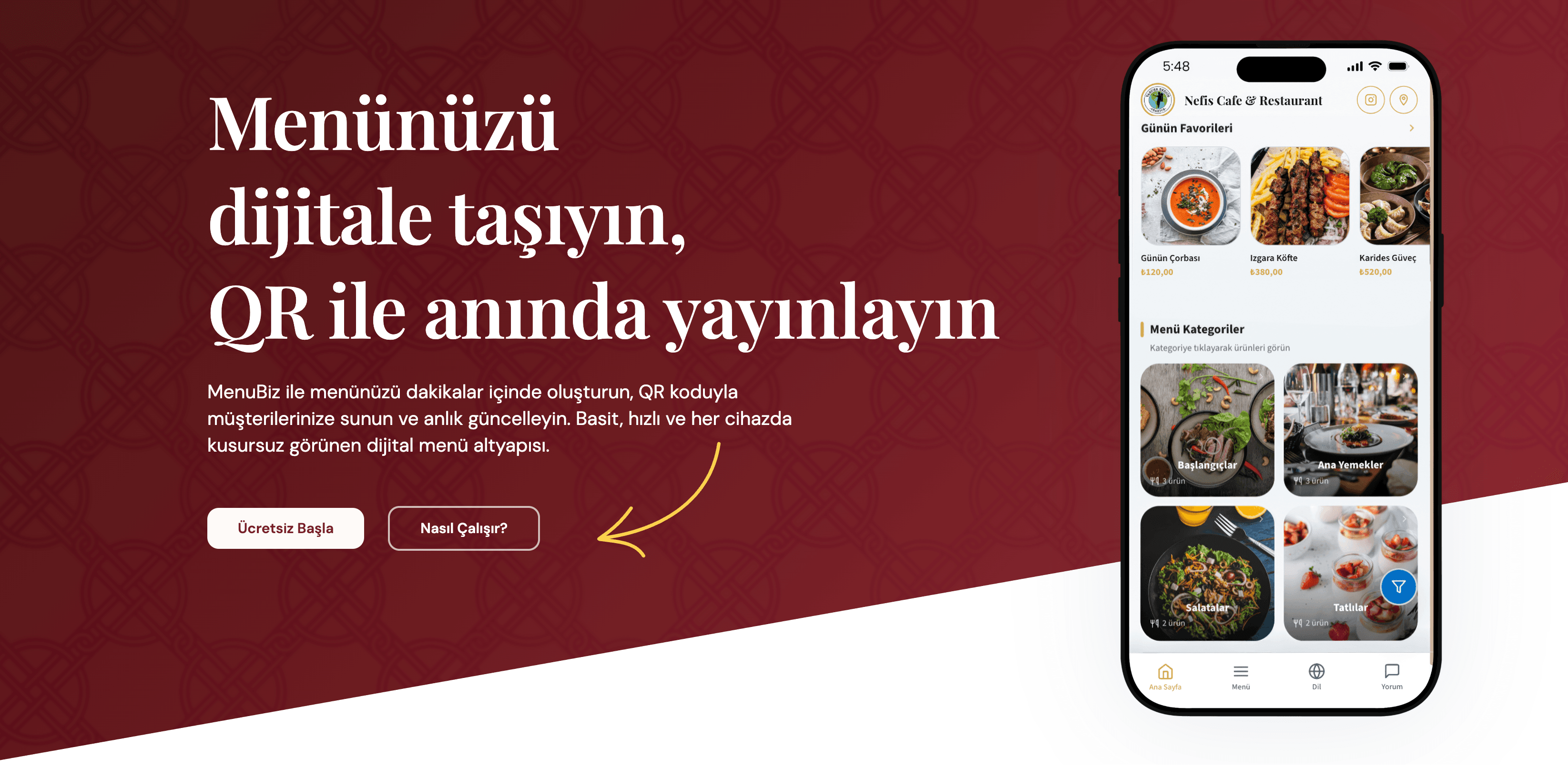
Fine Dining Digital Menu Platforms for Restaurants: 2026 Comparison and Why MenuBiz Stands Out
In fine dining and boutique restaurants, the menu is more than a price list. It is the first point of contact for brand identity, culinary philosophy, and guest experience. Printing paper menus is costly and difficult to update; PDF menus often deliver a low-quality, slow-loading experience. For these reasons, QR-based digital menu platforms have spread rapidly across the restaurant industry in recent years.
With dozens of solutions on the market, not all of them address the same needs. Some focus on fast ordering and POS integration, others on premium design and brand presentation, while others stand out through regulatory compliance and multilingual support. In this guide, we reviewed the leading fine dining-style online menu platforms and took a detailed look at MenuBiz as the standout solution in the Turkish market.
What Should You Look for in a Fine Dining Digital Menu?
For luxury and boutique restaurants, these criteria are critical when choosing a digital menu:
Design quality and brand alignment: The menu should reflect the restaurant’s ambiance; it should not feel like a generic web page or a plain PDF.
High-quality product images: In fine dining, visual presentation directly influences purchasing decisions.
Allergen, calorie, and nutritional information: With the 2026 nutritional value disclosure regulation, this is no longer optional but a legal requirement.
Multilingual support: English and other languages are essential, especially in tourist areas and restaurants serving international guests.
Instant updates: Daily changing menus, seasonal items, and price revisions should go live within seconds.
Speed and mobile performance: The menu should open instantly even on slow internet connections; fine dining guests should not be kept waiting.
Multi-branch management: For chains or restaurant groups, managing all branches from a single panel improves operational efficiency.
Leading Fine Dining-Style Digital Menu Platforms
FineDine
FineDine is one of the best-known QR menu platforms globally. It has a strong prestige portfolio with references from brands such as Hilton, Intercontinental, Godiva, and Nusr-Et. It offers high-quality visuals, calorie and allergen warnings, AI-powered smart product recommendations, and worldwide POS integration. It is positioned as an end-to-end solution including ordering and payment infrastructure.
Its strengths include international references, AI-based cross-selling recommendations, and multilingual support. However, it may be disadvantaged compared to local alternatives in terms of Turkey-specific legal compliance, local support, and pricing. Its order- and payment-focused structure may also feel overly complex for fine dining restaurants that only want a menu showcase.
Menyo
Menyo entered the market with a landing page tailored specifically to the fine dining segment. It offers elegant typography, minimalist QR codes, detailed wine list formatting, and automatic translation in more than 50 languages. Guests can apply allergen and diet filters themselves, reducing the need for waiter intervention.
Its strength is a premium theme approach focused on fine dining aesthetics. Its weakness is limited local support in Turkey, limited KVKK compliance emphasis, and limited focus on the 2026 nutritional value regulation. Pricing and setup also follow an international SaaS model.
QrToEat
QrToEat offers a special package for luxury restaurants in the Turkish market under the name Fine Dining Plan. Priced at 750 TL per month or 9,900 TL per year, it includes unlimited categories, unlimited products, table-specific QR codes, and brand hiding features.
It meets basic digital menu needs; however, it remains limited in AI assistant features, multi-branch management, analytics reporting, and premium template variety. Design options rich enough to reflect a fine dining restaurant’s brand identity are also limited.
QrMenum
QrMenum is developed by Goreel Works and holds a strong position in Turkey’s premium segment. It offers AI-powered image enhancement, translation in 32 languages, multi-outlet management, table heatmaps, and an analytics panel. It builds trust with hotel references such as Marriott, Hilton, and Ramada.
Its pricing starts from 5,000 TL per year, and its agency-led setup model is advantageous for businesses without technical knowledge. Its disadvantages are limited flexibility for restaurants that want self-service setup and the requirement for annual payment. Additional modules such as ordering and delivery also come with separate fees.
OddMenu
OddMenu is an international platform focused on real-time menu editing and modern design. It offers unlimited QR scans, instant updates, and a stylish interface. It provides enough design flexibility for fine dining; however, it falls behind local solutions on Turkey’s nutritional value regulation, allergen labeling standards, and local support.
MyDigiMenu
MyDigiMenu is a comprehensive platform that combines tablet menus and QR ordering infrastructure. It is suitable for hotels and large restaurant chains. It focuses more on operational order management than on fine dining presentation, so it may be too broad and costly for boutique restaurants that only need a digital menu.
MenuBiz: Why Is It the Most Balanced Choice for Fine Dining?
When we evaluate all these platforms in terms of technical infrastructure, design quality, legal compliance, price-performance, and suitability for the Turkish market, MenuBiz emerges as the leading solution. You can explore the platform at https://menubiz.com.tr.
Premium Design Aligned with Brand Identity
MenuBiz goes beyond ordinary PDF menus or generic templates. It offers premium themes suited to fine dining and boutique café aesthetics, such as ZenBordo, KafeBento, and Matcha. Menus customized with corporate colors by gourmet steakhouse operators preserve brand prestige in the digital environment as well. High-quality product images can be uploaded, which reduces order hesitation and increases average basket value.
MenuBiz makes the design quality offered by global platforms such as FineDine and Menyo accessible to Turkish restaurants at prices suited to local budgets and needs.
Full Compliance with the 2026 Nutritional Value Regulation
Food sensitivity and allergen management are now operational necessities for fine dining restaurants. MenuBiz supports calorie values, nutritional information, allergen labels (gluten, nuts, etc.), ingredient lists, and alcohol, pork, vegan, and vegetarian markings for every product. It provides full compliance with the 2026 nutritional value disclosure regulation.
This feature not only meets legal requirements; it also allows foreign guests to review the menu in their own language and make informed choices without asking the waiter. It significantly reduces operational burden for kitchen coordinators and chefs.
Instant Updates and Operational Flexibility
In fine dining and boutique restaurants, menus change frequently: daily specials, seasonal products, out-of-stock dishes, or instant price revisions. An update made in MenuBiz is reflected across all table QR menus within seconds. Paper menu printing costs and time loss disappear.
A boutique café in Kadıköy changing its coffee price in the morning and seeing the updated menu on all tables 10 seconds later is a concrete example of the platform’s operational speed. In home-style restaurants serving 15 different dishes every day, the menu can also be entered into the system within half an hour.
Speed: Fine Dining Guests Are Not Kept Waiting
MenuBiz menus are optimized to open instantly even on slow mobile internet connections. Lightweight infrastructure aligned with Core Web Vitals principles ensures guests reach the menu without waiting after scanning the QR code. This is critical for preserving first impressions in the fine dining experience.
Multi-Branch and Multilingual Management
Restaurant chains and hotel groups can manage all branch menus from a single panel. Category, product, price, and image updates are made centrally; branch-based differentiation is also possible. Thanks to multilingual support, international guests can read the menu in their own language.
Offering operational power similar to QrMenum’s multi-outlet structure, MenuBiz provides a more accessible entry point with its self-service setup model.
Artificial Intelligence and Bulk Upload
From the Standard plan onward, it offers an AI assistant and bulk product upload. It delivers value similar to QrMenum’s AI image enhancement module for quickly importing large menus, enriching product descriptions, and increasing operational efficiency; however, MenuBiz makes this accessible at a lower entry cost.
How Does a Fine Dining Restaurant Switch to MenuBiz?
The MenuBiz setup process consists of three steps:
First, a free account is created via menubiz.app. Registration is completed within seconds with business name, contact details, and password. Sign-in with Google or Apple is also available.
Second, categories and products are added from the management panel. Images are uploaded, allergen and nutritional information is entered, and the theme is customized with brand colors. The AI assistant and bulk upload feature make it easy to transfer large menus quickly.
Third, the generated QR code is placed on tables. Customers reach the menu in the browser without downloading an app. When a price or product change is made from the panel, it goes live instantly.
The entire process requires no technical knowledge; updates can be made without leaving the kitchen.
Frequently Asked Questions
Is a fine dining restaurant required to use a digital menu?
Although QR menu use is not legally mandatory for all restaurants, the 2026 nutritional value disclosure regulation requires transparent presentation of allergen and calorie information. A digital menu provides this compliance in the most practical way. It also offers operational advantages through savings on paper menu costs and instant updates.
How is MenuBiz different from a PDF menu?
PDF menus open slowly on mobile, do not support search, do not offer allergen filtering, and require re-uploading for updates. MenuBiz offers an interactive, fast, filterable, and instantly updatable experience. Brand identity is preserved with premium themes suited to fine dining aesthetics.
Can foreign guests view the menu in their own language?
Yes. MenuBiz offers multilingual support. The menu can be prepared in different languages; guests can read product details, allergen warnings, and calorie information in their own language without asking the waiter.
Can MenuBiz be tried for free?
Yes. New accounts start with a 10-day free trial; all features can be tested without providing credit card information. There is also a free plan that can be used indefinitely for up to 15 products.
Which plan should a fine dining restaurant choose?
The Standard plan is sufficient for single-branch boutique restaurants. Growing restaurants that want analytics, PDF print menus, and a digital waiter should choose the Professional plan. Multi-branch chains and corporate businesses that need a custom theme should choose the Master plan.
Conclusion
For fine dining and boutique restaurants, a digital menu is no longer a luxury but a core tool for operational efficiency and legal compliance. Although global platforms such as FineDine and Menyo have strong references, local solutions stand out in terms of Turkey-specific legal compliance, local support, and price accessibility.
While Turkey-based premium alternatives such as QrMenum and QrToEat also offer valuable options, MenuBiz delivers the most comprehensive package in the balance of design quality, 2026 regulatory compliance, instant update speed, multi-branch management, AI support, and transparent pricing.
For fine dining restaurants that want to eliminate paper menu costs, preserve brand prestige digitally, offer multilingual menus to foreign guests, and achieve full compliance with allergen regulations, MenuBiz is the first platform worth evaluating in 2026.