
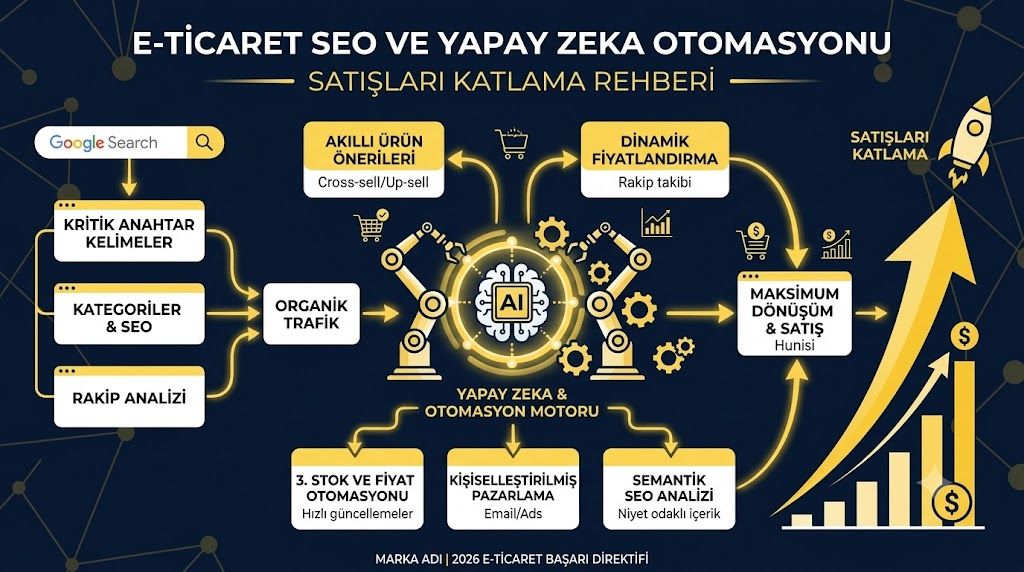
A Guide to Multiplying E-Commerce Sales with SEO and AI Automation
According to current data, more than 60% of e-commerce site traffic comes from organic searches. E-commerce SEO strategies are the only guaranteed way to reach purchase-ready audiences without getting lost among millions of products. However, in such a competitive landscape, manual optimizations are no longer sufficient. Search engines elevate sites that load in under a second, understand user intent, and deliver personalized experiences. If you want to accelerate your organic growth and reduce advertising costs, you're in the right place. Let's walk through step by step how to transform your e-commerce operations into a sales machine using next-generation technologies.
Table of Contents
• How Does AI Integration Work in E-Commerce?
• – Smart Product Recommendations and User Experience
• – Inventory and Pricing Control
• The Impact of Conversion-Focused Web Design on Rankings
• 4 Steps to Elevate Your Software Infrastructure
• Frequently Asked Questions
• Conclusion
How Does AI Integration Work in E-Commerce?
At the heart of a successful e-commerce strategy lies the ability to process data correctly. An AI integration that analyzes users' search histories, abandoned cart items, and time spent on site automatically optimizes the sales funnel. Showing visitors exactly what they're looking for causes Google to label your site as an "authoritative source that benefits users."
Smart Product Recommendations and User Experience
You must prevent users from getting lost in categories that don't interest them. Algorithms that track visitors' real-time behavior present them with personalized product showcases. Increasing dwell time directly boosts SEO metrics. Based on data we've observed in our own projects, personalized algorithms have driven increases of up to 45% in page views per session.
Inventory and Pricing Control
In a structure with thousands of products, manually conducting competitor analysis and price updates is impossible. An automation system running continuously in the background pulls market data in real time. Users landing on broken pages (out-of-stock products returning 404 errors) send negative signals to Google. With automatic redirects and dynamic inventory management, you avoid wasting search engine crawl budget.
The Impact of Conversion-Focused Web Design on Rankings
Your site's visual appearance alone doesn't generate sales. A mobile-first web design with clean code structure is the driving force behind SEO performance. Google's Core Web Vitals update proved that speed and stability are not optional recommendations but absolute requirements.
Metric Comparison:
Image Optimization
Standard: Heavy JPEG files, slow loading
SEO & AI Focused: WebP format and smart lazy-loading
Product Search
Standard: Only exact-match keywords
SEO & AI Focused: Semantic understanding and NLP-powered search
User Journey
Standard: Complex steps, high cart abandonment
SEO & AI Focused: One-click checkout and dynamic UX design
4 Steps to Elevate Your Software Infrastructure
Lasting success begins with a solid foundation in code. Here are the critical integration steps that will take your site to the next level:
1. Schema Markup (Structured Data) Setup: Display product prices, stock status, and customer reviews directly in search results. Instantly boosts your click-through rate (CTR).
2. Speed and Cache Optimization: Opt for advanced software architectures that reduce server response times.
3. Content Automation: Set up systems integrated with language models that enrich product descriptions with unique, long-tail keywords.
4. Continuous Auditing: Deploy back-end systems that instantly detect and resolve technical SEO errors.
Managing all these technical processes in-house can create significant cost and time inefficiencies. At this point, custom infrastructure developed by a specialized agency saves you from months of trial and error.
Frequently Asked Questions
How does AI-powered web design affect SEO?
Algorithmic design processes analyze which areas of a page users click on most and improve the layout accordingly. This reduces the bounce rate and signals to search engines that your site delivers a high-quality experience.
Is automation expensive for e-commerce sites?
While it requires an upfront investment during the initial setup phase, the ROI (Return on Investment) is extremely high in the long run, as it reduces manual labor to zero and increases organic sales.
Do I have to completely replace my old infrastructure for SEO?
Not necessarily. A strong software team can integrate the necessary modules into your existing platform via APIs. However, if the core code is very outdated, migrating to a new architecture will be the healthier choice.
Conclusion
In summary, getting your e-commerce site to the first page of Google requires not just ordinary effort, but the perfect alignment of high technology and the right strategy. The platform where you showcase your products must be a system woven with SEO principles in the background, accelerated by automation, and crowned with modern architecture.
If you want to outrank your competitors in organic searches, put your sales processes on autopilot, and discover our end-to-end digital solutions tailored to your business, don't waste any time — contact our team now and let's start analyzing your project right away!